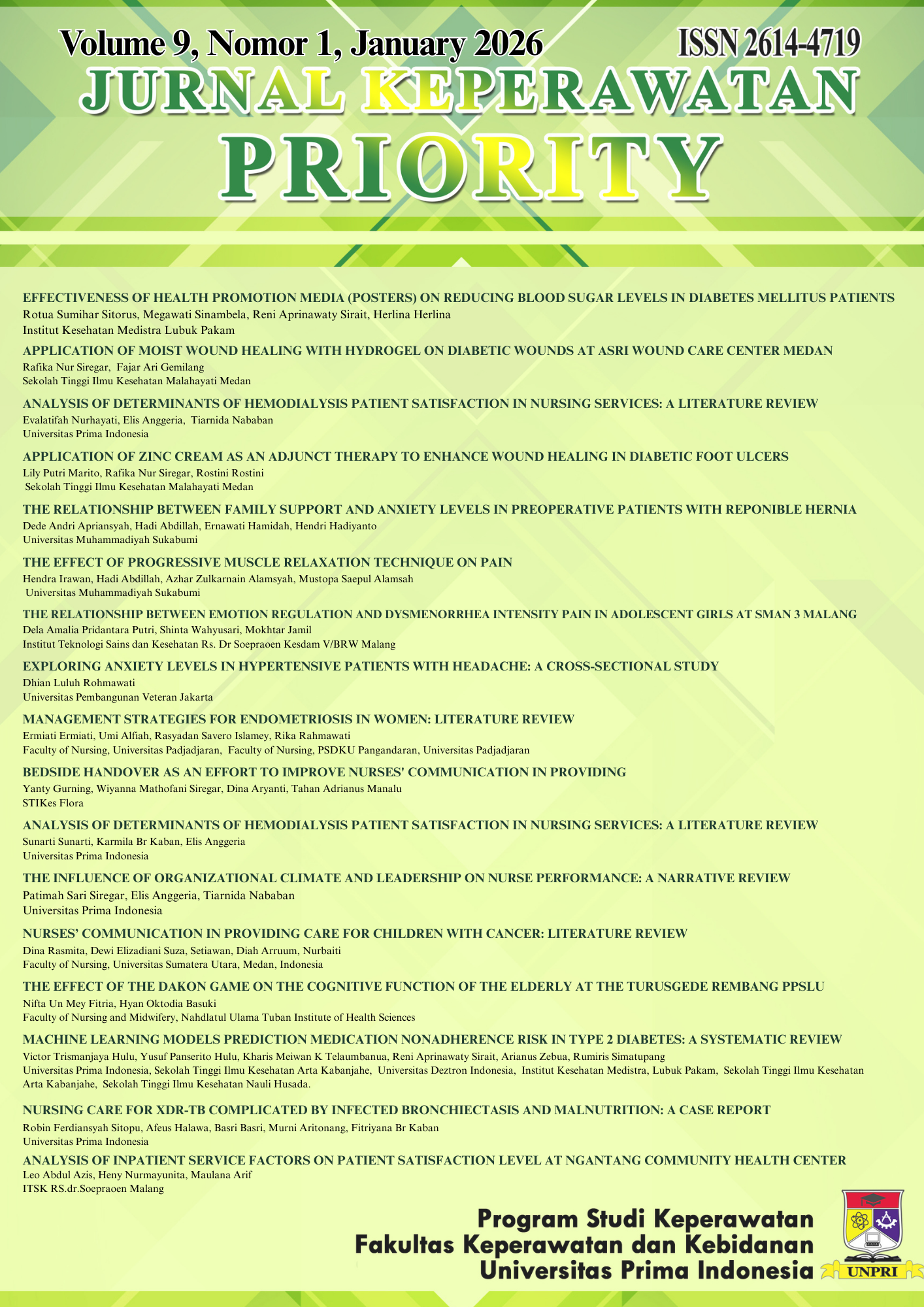
Machine Learning Models Prediction Medication Nonadherence Risk in Type 2 Diabetes: A Systematic Review
DOI:
https://doi.org/10.34012/jukep.v9i1.7859Keywords:
Diabetes mellitus, medication non-adherence, diabetes medication consumption, machine learningAbstract
The prediction of medication nonadherence among patients with T2DM can be improved in accuracy and speed using machine learning (ML). This study aimed to develop an ML model to predict the risk of medication nonadherence among patients with T2DM. Methods, inclusion criteria comprised English-language, open-access journal articles published between 2020 and 2025 that developed and validated ML–based prediction models, including ensemble methods, gradient-boosting models, SVMs, and neural networks. Exclusion criteria included review articles, non-English papers, studies published before 2020, studies lacking prediction model development or validation, and studies using only traditional statistical methods, such as logistic regression. The article search was conducted in PubMed, Scopus, ScienceDirect, and Google Scholar. Prediction Model Risk of Bias Assessment Tool (PROBAST) to assess the methodological quality and usefulness of the qualified studies. This narrative synthesis examines the characteristics of ML-based prediction models, their performance, and the factors that predict adherence among patients with T2DM. The papers were sourced from various scientific journal databases. The results show that cross-sectional and cohort studies were among the research designs used in the five papers reviewed. The AUROC of the internal test was 0.782, and the AUROC of the external test was 0.771. The learned-feature classification model achieved an average accuracy of 79.7%. Among these algorithms, the AUC of the best-performing algorithm was 0.866 ± 0.082. The SVM classifier outperformed the others, achieving a recall of 0.9979 and an AUC of 0.9998. The conclusion indicates that predictive capacity is influenced by clinical metrics and the number of prescribed medications.
Downloads
Published
How to Cite
Issue
Section
License
Copyright (c) 2026 Victor Trismanjaya Hulu, Yusuf Panserito Hulu, Kharis Meiwan K Telaumbanua, Reni Aprinawaty Sirait, Arianus Zebua, Rumiris Simatupang

This work is licensed under a Creative Commons Attribution 4.0 International License.
Authors who publish their manuscripts through the Journal of Keperawatan Priority agree to the following:
- Copyright to the manuscripts of scientific papers in this Journal is held by the author.
- The author surrenders the rights when first publishing the manuscript of his scientific work and simultaneously the author grants permission/license by referring to the Creative Commons Attribution 4.0 International License to other parties to distribute his scientific work while still giving credit to the author and the Journal of Journal Keperawatan Priority as the first publication medium for the work.
- Matters relating to the non-exclusivity of the distribution of the Journal that publishes the author's scientific work can be agreed separately (for example: requests to place the work in the library of an institution or publish it as a book) with the author as one of the parties to the agreement and with credit to Journal of Journal Keperawatan Priority as the first publication medium for the work in question.
- Authors can and are expected to publish their work online (e.g. in a Repository or on their Organization's/Institution's website) before and during the manuscript submission process, as such efforts can increase citation exchange earlier and with a wider scope.